
Improving customer experiences and services
Customer Interaction
Understanding and interacting effectively with customers is one of the critical elements of a company's success. It ranges from understanding their needs and preferences to prioritizing which customer segments to focus on, and extends across all interactions - from the first sales contact to after-sales support. All touchpoints share one common risk: mistakes can result in significant opportunity costs in the form of profits never made.
AI tools can be great helpers in these efforts. If applied well, solid machine learning approaches can find the hidden gems in a large customer database, identify the potential needs of those customers, and guide them to buy more products with higher profitability. Then, using Natural Language Processing (NLP) tools can greatly improve sales conversion rates, reduce customer service efforts and increase customer satisfaction and retention.
Unfortunately, in many cases, AI-based customer analysis and interactions are implemented with the opposite effect, where customer analysis data generated by an AI-powered black box creates results far inferior to human analysis. The biggest problems, however, are created by AI-driven interactions: most of us have already experienced AI chatbots that were the opposite of helpful. This is also evident in our AI chatbot audits, which highlight substantial room for improvement in many implementations.
Below, you find more information on examples of customer-focused AI and its potential. Each reveals more details when you click them. And: please feel free to reach out to us to learn how we can help you use these technologies!
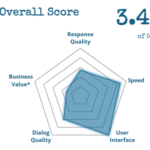 The 9senses Chatbot Audit evaluates the performance of your chatbot from a user perspective.
 Before AI, testing followed specific cycles and became a key part of all DevOps procedures. With AI, things change with every turn. How do quality assurance and testing keep up?
 When we are using generative AI, to create new output we are exploiting knowledge previously generated by humans. But who is rebuilding knowledge for the next generation?
 9senses Market Analysis: Only 16 out of 129 automotive providers in the DACH region use AI chatbots for customer service - with significant variations in quality
 AI lets us skip the slow, clumsy, error-prone work of becoming competent. The bill for that shortcut arrives in the future, when the people who were supposed to replace today's…
 Large Language Models judge your work differently every time you ask. That is not just a quirk of the technology - it is a fundamental challenge to how we create,…
 AI hallucinations aren't random - they cluster, systematically and predictably, in the topics you cannot independently verify.
Customer Interaction Topics
Chatbots
A chatbot on your website that helps prospects and customers is available 24/7 and has access to all the relevant knowledge.
Call Centers
Supporting or fully automating voice-based customer interactions is an area where carefully designed AI can play a major role.
Customer Care and Services
Fully or partially auto-mating front-facing workflows improve customer experiences and reduces cost.
Customer Insights
Understanding and prioritizing your customers better, finding opportunities and detecting fraud helps to better focus business effort.
They are springing up like mushrooms on many websites, those little boxes on the lower right corner offering instant help by an "AI Assistant". And the idea is indeed fascinating: an electronic employee that is available 24/7, never gets tired and knows more than even the most experienced sales or customer care person. On top of that it can eliminate workload on employees, reduce wait times and provide answers much faster than a human could.
In most cases, as we all experience when trying out those AI bots, they fail at very mundane tasks and are plagued by many of the problems inherent to Natural Language Processing. The Chatbot Audit developed by 9senses shows that many bots do not even get close to exploring their potential.
Benefits of a good chatbot
A well-designed chatbot can create big benefits, driving sales and customer satisfaction up, while decreasing labor cost for sales and customer service employees. Below are a few key numbers from various studies evaluating key benefits.
%
reduction in resolution time
%
reduction in customer service minutes
%
increase in direct sales conversions
%
increase in customer satisfaction
Adding AI-based interactions to phone-based services can also significantly improve both revenue and customer satisfaction, particularly when it comes to intent recognition and distribution of calls. Compared to chatbots, the implementation paths are similar, while the challenges are vastly different.
First and foremost, automated call flows almost always need the potential for a human escalation path and thus must be integrated with call center solutions that can transfer to a human. Often, AI-driven call management is most successful once it excels at intention detection and directing calls into the correct pipeline - be this an automated response solving a problem, a redirection to a human agent, or a dedicated customer care and service workflow that may be fully or partially AI-supported.
Then, there are the challenges that exist far less in text-based interactions. Understanding dialects, non-native speakers, filtering background noises or dealing with bad voice line quality can negatively impact conversations, and needs clear exit paths, making the design of call center interactions more challenging.
And last, but not least, we have rarely ever seen pure AI solutions in successful call center applications, most are hybrid approaches, where AI-driven Natural Language Processing is heavily used in intent recognition and output generation, while many of the workflows are supported by logic and rules. Finding this balance is the most important element of successful call center implementations.
AI-supported customer care solutions help streamline service and support processes, deliver consistent, high-quality responses across channels - while reducing operational costs and response times. For simple requests, they are already capable of handling them completely independently.
Often, these services are integrated into chatbots and call center solutions, sometimes they are only implemented in the backend processing of inputs received on traditional pathways, e.g. through letters or online forms.
The key differentiator is that these implementations are almost never plain AI solutions based on Machine Learning, but rather hybrid systems that combine the ease of using normal language in interactions (e.g. compared to filling a complicated long form) with strict and well-tested business logic that then turns the inputs into actionable business workflows with a tangible outcome, a service process completed with all feedback and audit checks, a satisfied customer, and - if possible - limited to no involvement of humans in simple and boring tasks that consume time.
Understanding your customers at a deeper level is the foundation of sustainable growth. Data-driven customer insights reveal behavioral patterns, unmet needs, and value drivers that often remain hidden in complex data environments. AI-powered analytics enable companies to act on this data in ways that were previously out of reach. Typical applications include:
- Customer segmentation - moving beyond basic demographics to behavioral and value-based clusters that allow truly targeted engagement.
- Churn prediction - identifying customers at risk of leaving before they do, enabling timely and personalized retention measures.
- Next-best-action and offer optimisation - using purchase history, browsing behaviour, and contextual signals to guide customers toward products and services most relevant to them.
- Fraud detection - identifying anomalous patterns in real time to protect both the business and its customers.
- Lifetime value modelling - prioritizing effort and investment toward the customers and segments with the highest long-term potential.
What these applications share is a dependence on clean, well-structured data and thoughtful model design. A segmentation model built on poor data will produce poor segments - and acting on them can be worse than acting on intuition alone.
For a deeper look at the data foundations that make reliable customer insights possible - including data pipelines, knowledge management, and analytics architecture - visit our Data and Knowledge Management page.
Setting up customer interactions successfully
Successfully setting up customer-facing AI - irrespective of it being a chatbot, call center automations or service workflows - requires structured planning, iteration, and ongoing refinement. Like training and coaching a new employee is essential, even advanced out-of-the-box systems need significant tuning before they reliably serve customers and support business goals. The most effective implementations define clear objectives, prototype rigorously, implement with governance in mind, and continuously test and improve responses.
Please contact us to discuss your needs and ideas. We are looking forward to working with you on a successful solution that truly helps your business.