
9senses in the
News
 AI hallucinations aren't random — they cluster, systematically and predictably, in the topics you cannot independently verify.
 Conversational AI is dominated by English, with serious consequences for other languages that are structural and can only be resolved with significant effort.
 Renowned AI experts attribute a significant chance to AI that it could lead to the end of humanity. Is that a realistic prediction or doomsday talk? Short answer: it's not AI that's the problem, it's us.
9senses: AI veterans to clear hype around AI

New AI consulting firm focuses on measurable AI results and
establishes quality standards for the responsible use of AI
9senses AG, a new global AI consulting firm with Swiss roots, will begin operations in early 2026. 9senses set itself the goal of putting AI to use beyond the hype and marketing promises—with measurable business value, clear ethics, and technical depth.
Behind 9senses is a growing team of AI veterans with decades of practical experience in research, industry, and management consulting. The founders were already working on non-linear software applications long before AI became a buzzword. This experience enables vendor-neutral consulting - free from recommendations driven by vested interests.
"Like any powerful medicine, AI can help or harm — the difference lies not in the tool itself, but in the wisdom of those who use it."
Dr. Johannes Kunz, Founder and CEO
A key goal is to establish measurable quality standards in the AI sector, demystify AI, and serve as a resource for both businesses and society, bringing clarity to the “AI fog.”
What's next?
9senses is in the process of establishing industry-wide benchmarks for independent AI quality assessment and to develop governance frameworks that enable companies to independently review and plan their AI implementations. At the same time, a training program will be developed to make AI concepts accessible to executives and decision-makers. A key focus will also be on the SME and educational market, where AI is changing the world faster than the people in charge can master.
Some key aspects of 9senses work are:
- Establish AI standards:
Embed objective quality assurance as an industry standard. - Ethical AI instead of hype:
Responsible AI implementations with clear governance structures. - Demystify AI:
Provide knowledge and a basis for decision-making for executives who neither fear nor blindly trust AI.

More News

A confident confabulator
AI hallucinations aren’t random — they cluster, systematically and predictably, in the topics you cannot independently verify.

Lost in Translation
Conversational AI is dominated by English, with serious consequences for other languages that are structural and can only be resolved with significant effort.
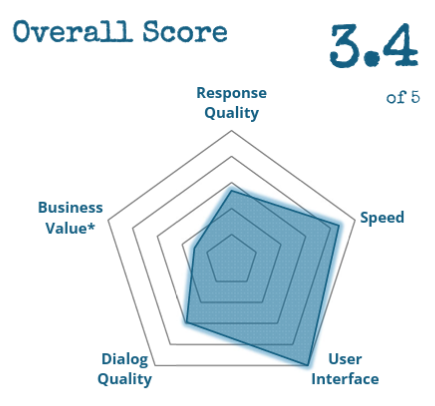
9senses Chatbot Audit makes Gen-AI quality measurable
A structured evaluation process for AI chatbots makes it possible for the first time to benchmark generative AI systems -independently, cost-effectively, and quickly

Can AI end humanity?
Renowned AI experts attribute a significant chance to AI that it could lead to the end of humanity. Is that a realistic prediction or doomsday talk? Short answer: it’s not AI that’s the problem, it’s us.

9senses: AI veterans to clear hype around AI
New AI consulting firm focuses on measurable AI results and
establishes quality standards for the responsible use of AI
Talk to Eliza
This is a faithful representation of the 1966 Eliza version created by Joseph Weizenbaum. It was reproduced by Anthony Hay in C++ based on the original 1965 code and updated by behavior transcripts of the final version.
Note: The paper version emulates Joseph Weizenbaum's original 1966 ELIZA as it ran on the CTSS time-sharing system (IBM 7094) at MIT, accessed via an IBM Selectric-based hardcopy terminal. On CTSS the question mark served as the line-delete (line-kill) control character, so it could not appear in typed input — and the DOCTOR script accordingly produced no question marks. They are therefore suppressed here, on both sides of the conversation. The green "terminal" version enables question marks instead; it represents a glowing CRT display of a kind that did not exist for ELIZA in 1966 and evokes a later era of computing.
Play Chess like 1997 (Deep Blue Style)
Here's our simulation of Deep Blue. You can play against Stockfish (able to run on a laptop today with similar strength compared to Deep Blue). Bonus: you can replay the legendary 1997 rematch where Deep Blue won against Garry Kasparov.