

Listen to this post
With Generative AI, we risk stealing from our own future
When we are using generative AI, to create new output we are exploiting knowledge previously generated by humans. But who is rebuilding knowledge for the next generation?
Using Generative AI is very convenient. Need a nice presentation on last year’s sales? Give it the raw data and a bit of direction, and a few minutes later, you have that PowerPoint that took you a day to prepare in the past. Need a simple app that supports your fitness goals? AI can write it for you in minutes. Or it can create an infographic with photorealistic medical illustrations. And many other things. It can even write songs or poems, and if you tell it what style you like, it can match it quite well.
It can do so because it has been trained on pretty much everything that is openly available to humanity on the Internet, augmented by more non-public source materials. Hundreds of medical illustrations, thousands of previously sung songs, millions of open-source code examples available on GitHub, it’s all there for AI models to ingest and reproduce something new and mostly useful for us.
Drawing on that is what makes those tasks so easy. Human creation often is also repetition, and processing what has previously been created is what every new creator does anyway. This is how we learn, and it’s an important concept of human innovation.
But for us humans, this is a starting point, for AI and those who rely on it is where it ends.
For humans, digesting and copying are catalysts of innovation. For AI and those who rely on it, they are the end points.
Johannes Kunz, CEO 9senses
AI is a very competent recycler
As described elsewhere, a model based on deep learning doesn’t reason about meaning; it moves through a space of vectors, finding the nearest plausible continuation. In practice, that makes it exceptionally good at recombining existing forms, styles, structures and solutions into something that feels coherent, relevant and useful. Generation, no matter what, is interpolation, potentially extrapolation if well guided by a resourceful human. But usually, the model produces something near the center of everything similar it has seen. And it has seen many sales presentations, analyzed many songs, read many poems.
Likely the better ones, because they are shared, discussed, appraised. So statistically, the output is near the center of its available input, weighted by the signals that suggest good quality.
This is not just theory. Doshi and Hauser showed experimentally (Science Advances, 2024) that generative AI can make the individual writer’s story better – and the collection of everyone’s stories more alike. The tool lifts each of us slightly above the middle, and pulls all of us toward the same level.
For most everyday uses, this is exactly right. A sales presentation doesn’t need to be super-creative, a simple report about a pharmaceutical trial mostly needs to fit the bill and check all the boxes, a marketing jingle needs to sound catchy. There is no rocket science involved. And: recent AI models have become so good at this recycling job that they can produce very useful and targeted output. Denying it would be lying to ourselves.
But they are good at it exactly because they have all those inputs, created in the past centuries by competent, creative or even genius humans. They were trained on the work of people who learned their craft over time, through repetition, mistakes, correction, and experience. Many started their professional or creative lives with simpler tasks, building experience, building knowledge, training their brains to one day create something good. That’s how we learn, from others, and from our own mistakes. If AI increasingly replaces that work, the supply of future expertise becomes uncertain. That’s the input. For us and for AI.
Muscle atrophies without training – so does the brain
Expertise and skill are built through repetition, trial and error, correction, and sustained attention. Human brains can be compared to muscles in that respect. They become stronger as they are being used. There is a reason we call it training. In school, while studying for a job, and most importantly, while we learn doing things. Those first steps, sometimes clumsy, sometimes leading to upsetting failures, are what make us good at what we are doing.
Now AI is breaking that training. Hard. Students who write their essays with AI are not really doing the tedious work of researching, digesting, and laying out a stringent argument; software developers who code or debug with AI don’t make all the mistakes we made when coding in the past. We might even be discouraged by our employer or ourselves from trying to do something that AI can do better than what we can do. And this is what slows down or even stops the training of our brain.
The evidence for this is no longer anecdotal. In a mixed-methods study of 666 participants, Gerlich (2025, Societies) found that heavier AI use was associated with weaker critical thinking, mediated by what he calls cognitive offloading – and the effect was strongest among the youngest users, aged 17 to 25, precisely the group still building their capabilities. A study of 580 university students (Tian and Zhang, 2025, Acta Psychologica) points the same way: the more students depended on AI, the lower their critical thinking scored. And the MIT Media Lab’s Your Brain on ChatGPT study (Kosmyna et al., 2025) offers a striking illustration of the mechanism: using EEG to compare people writing with an LLM, with a search engine, and with nothing at all, it found the LLM group showed the weakest neural connectivity, produced markedly more homogeneous writing, and – not surprisingly – often couldn’t quote a line from essays they had just “written.” They never really engaged with the material. The authors call the residue “cognitive debt”. That is the bigger risk: AI can help us finish tasks faster, while reducing the mental work through which our capabilities develop.
What makes this more than a worry about lazy students: the same erosion has now been measured in accomplished professionals. A multicenter study published in The Lancet Gastroenterology & Hepatology (Budzyń et al., 2025) looked at endoscopists who had worked with AI-assisted colonoscopy for a few months – and found that when the AI was switched off, their unassisted detection rates dropped. We are talking about experts who had already mastered their craft; the tool eroded a skill they had spent years building. The next generation might never build that skill in the first place.
A vicious cycle
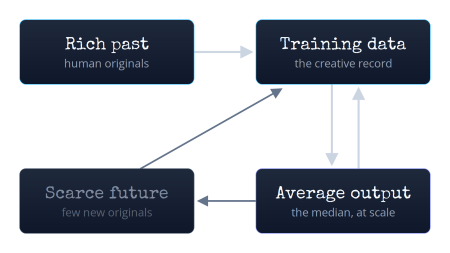 The vicious cycle
So what is likely to happen? Becoming genuinely capable will be harder, becoming extraordinary will take enormous willpower to overcome the hurdles created by a never-tiring and already competent competitor called AI. We might not even develop the self-confidence to do so, because everything we have previously done was created with the help of AI and isn’t truly the product of our own doing.
The final consequence of this cycle is that the vast flow of current and past human input that feeds society (and AI training) will be reduced to a trickle, and AI will mostly feed on its own output.
To keep the argument honest: recombination is a real and legitimate part of human creativity too – we shouldn’t romanticize the blank page. The decisive difference isn’t that recombination is bad, it’s that AI can’t do more than that without creative humans directing it. And these creative humans might exist less and less in an AI-driven future.
The path of least resistance
If AI now does this for us, without hesitation, super-fast and mostly in a quality that is more than acceptable to us, and to those who receive the output, things become easy in the beginning, and difficult later. If AI delivers “good enough” interpolated output that is nearly free and instant, the slow, costly, uncertain work of origination loses the incentive competition every time. There’s a Gresham’s-law logic to it: cheap, frictionless reproduction tends to crowd out expensive, effortful creation. That’s what turns a theoretical risk into a real, observable trend.
But: technology fear is not new, and it was never justified…
The negative impact of newly arriving technologies was discussed many times before. Everything from the steam engine to electric light to computers was seen as the end of human craft by some people, but ultimately, human creativity survived each time. We became faster and richer on the way.
So why is Generative AI different? People will use it, and get used to it, and everything is more efficient and faster. It’s just the same, isn’t it?
It isn’t. Earlier tools automated execution or reproduction and left origination to humans. None of these tools trained on their own outputs to produce the next output. The camera never ingested every prior photograph in order to generate the next one: the photographer remained the artist. The structurally new feature here is the loop: the tool’s raw material is human creativity, and its outputs flow back into the very pool it draws from, while human input becomes scarce. That feedback is the thing that’s truly different this time.
And we already know where that loop leads. When Shumailov and colleagues trained models on the output of earlier models, the models degraded – a process they documented in Nature (2024). They named it “model collapse”. Tellingly, the damage doesn’t start at the average: the rare and the exceptional vanish from the distribution first, until what remains converges on a narrow middle. Later research found how collapse can be avoided, by continually mixing fresh, real, human-made data into the training pool (Gerstgrasser et al. 2024; Kazdan et al. 2025).
Please read that again: the machines’ immune system against their own mediocrity is us, still making new things. Which is precisely the supply that is drying up.
And this is no longer a laboratory scenario. A Stanford-led analysis of the Internet Archive found that by mid-2025, roughly a third of newly published websites were AI-generated or AI-assisted. And more AI text on the internet inversely correlates with semantic diversity. The variance in how texts are written has measurably narrowed since 2022; large-scale studies of student writing confirm the trade-off: average quality is up, diversity of thought is down. No amount of clever prompting closes this gap. The feedback loop is not a thing of the future; it is already here.
To be fair to the evidence: none of this appears to be destiny. Gerlich found that higher education buffers against cognitive offloading; follow-up work on the Doshi-Hauser experiment shows the homogenization effect can be reduced by deliberately diversifying what the AI proposes; and studies of guided, scaffolded AI use in education find that critical thinking can be preserved or even strengthened – when the human stays in the reasoning loop. Which is precisely the point of this article: the risk is not baked into the technology. It follows from how we choose to use it.
There is no easy answer to this problem
We use AI to do things that we would previously have had done by humans. We do it for many reasons: for convenience, to save time or money, AI use is becoming unavoidable because it will make those who don’t use it less competitive in producing their “average” output. It will still provide opportunity for the truly creative and outstanding among us. But how will they learn to become confident innovators in this environment?
This is a job for society. For people with foresight. Those who understand that the greatest capital of humanity is its ability to innovate, to solve unknown problems with new ingenious ways. And that the investment into this capital is training, hard work, and ensuring that each new generation can make their own mistakes.
On a personal level, the remedy fits in one sentence: use AI as augmentation, not as origination. Let it provide inputs, review and spell-check, surface options and challenge your arguments – but reserve the first idea, the search for the right logic, the flow and the key arguments, to yourself. And apply YOUR final judgment. Treat AI output as yet another input into your work, not as an endpoint to ship. The models’ own health depends on people who still make things that never existed before – as does ours.
References and further reading
Research
Budzyń, K., Romańczyk, M., Kitala, D., et al. (2025). Endoscopist deskilling risk after exposure to artificial intelligence in colonoscopy: A multicentre, observational study. The Lancet Gastroenterology & Hepatology, 10(10), 896-903. DOI: 10.1016/S2468-1253(25)00133-5.
Doshi, A. R., & Hauser, O. P. (2024). Generative AI enhances individual creativity but reduces the collective diversity of novel content. Science Advances, 10(28).
Gerlich, M. (2025). AI tools in society: Impacts on cognitive offloading and the future of critical thinking. Societies, 15(1), Article 6. DOI: 10.3390/soc15010006.
Gerstgrasser, M., et al. (2024). Is model collapse inevitable? Breaking the curse of recursion by accumulating real and synthetic data. arXiv preprint arXiv:2404.01413.
Kazdan, J., Schaeffer, R., Dey, A., Gerstgrasser, M., Rafailov, R., Donoho, D. L., & Koyejo, S. (2024). Collapse or thrive? Perils and promises of synthetic data in a self-generating world. arXiv preprint arXiv:2410.16713.
Kosmyna, N., et al. (2025). Your brain on ChatGPT: Accumulation of cognitive debt when using an AI assistant for essay writing task. MIT Media Lab. arXiv preprint arXiv:2506.08872.
Shumailov, I., Shumaylov, Z., Zhao, Y., Papernot, N., Anderson, R., & Gal, Y. (2024). AI models collapse when trained on recursively generated data. Nature, 631, 755-759.
Stanford University, Imperial College London, & Internet Archive. (2026). The impact of AI-generated text on the internet.
Tian, J., & Zhang, R. (2025). Learners' AI dependence and critical thinking: The psychological mechanism of fatigue and the social buffering role of AI literacy. Acta Psychologica, 260, Article 105725. DOI: 10.1016/j.actpsy.2025.105725.