
Thriving in Times of AI
AI Business Transformation
AI is changing every business, without anyone ever making a decision. A company that goes slow or "no" on AI will still have AI tools coming in as part of the software and equipment it uses, and by employees running AI chats on their devices without authorization, training and documentation. For some companies, competitors suddenly might have an edge because they embrace the technology. Escaping AI is impossible - the only choice is how to engage. How a company responds to the AI exposure it already has defines its AI Identity.
“Sir, my need is sore.
Spirits that I’ve cited
my commands ignore.”
The Sorcerer’s Apprentice, Johann Wolfgang von Goethe (1797/98)
What is your AI Identity?
9senses has defined three archetypes of AI identities companies can have. Learn more by opening one of the tiles below, or take our 5-minute test to find out where your company stands.
AI Hesitant
The AI Hesitant does not actively engage in AI, but AI is still creeping in through third-party tools and unauthorized AI use by employees.
AI Sprinter
The Sprinter embraces AI without hesitation - and might reap some short-term benefits but might endanger control over the business long term.
AI Wise
An AI Wise company finds the right balance between adopting AI and maintaining control. Its foundations are sound, and its investments are targeted.
From the inside, the Hesitant position feels safe. No budget is burned on hyped AI that is more likely to fail than to succeed, no risky projects are started, and employee use of AI chats is blocked.
Unfortunately, the defining property of AI is that it does not wait for an invitation. It just arrives. The software you already pay for adds AI features release by release, and your people are ahead of you: in the largest global study on workplace AI to date, only 40% of employees said their workplace has any policy or guidance on generative AI, while almost half admitted to using it in ways that break company rules, including feeding sensitive company information into free public tools. 57% said they hide their AI use altogether.
There isn't a "no-AI" option
While it is possible to decide nothing on AI or even actively say "NO", you are still fully exposed. The EU AI Act is in place, and a purchased product or an illegitimately used chatbot can put you in scope for rules you never read.
If you contacted us tomorrow, our advice would not be an AI project. It would be to build the AI Foundation and AI Baseline to cover you. It would mean training your senior management to build some basic understanding of AI. It would mean an inventory of what is already in your company, estimating the exposure, defining rules and boundaries, and setting up minimal training and support for employees who are very likely already using AI behind your back.
Take the AI Identity test and find out which company type yours is - or schedule a 15- minute call to learn more about how we can help.
The price
AI Hesitants pay
You carry the exposure without most of the benefits. You pay for AI inside your tools whether it is governed or not.
One pasted contract, one confidently wrong answer sent to a customer, and the incident lands on an organization with no rules, no owner and no routine. But full responsibility. And when engaging becomes unavoidable, you start under pressure instead of by choice.
FAQs for AI Hesitants
Deciding against your own AI applications is entirely legitimate, and we often advise companies to do just that. Deciding against AI, while it creeps in through tools and illegitimate use by employees, is impossible. The exposure exists whether you engage or not; the only choice is whether it is covered.
Blocking is the worst possible decision. It doesn't remove tool use, it just shifts it outside the visible area. Teams or individuals that are under pressure to deliver output will simply switch to AI on private devices, which often means lower-quality models, privacy and confidentiality issues, and a complete loss of control over what is going on. Approved alternatives, combined with training and clear rules, reduce unauthorized use far more effectively than a ban.
The first step is learning about AI in order to understand what it can do, and what it cannot. This is followed by measuring: creating an inventory of where AI already lives in your organization and how it is governed. This takes days, not months. Everything else builds on this.
The Sprinter is visibly the innovator, ahead of the curve, using the latest technology and possibly scoring some quick wins. Some of those gains are real; maybe well-used AI increases staff efficiency and reduces hiring needs.
But still, a large number of generative AI pilots produce no measurable return, and, increasingly, companies are abandoning AI initiatives. The pattern behind these numbers is always the same: applications are added faster than the foundations that keep them controllable, ranging from appropriate testing to governance.
Sprinters often steal from their own future
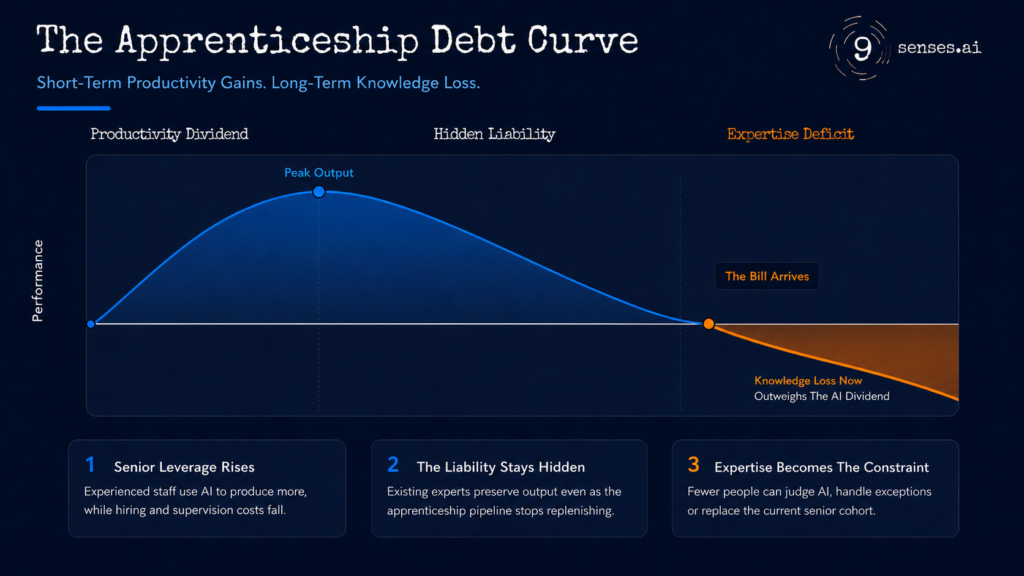
The deeper cost compounds: in a 2026 BCG study, C-level interviewees observed deskilling among their employees who heavily rely on AI-generated output and complained about glossy work that was shallow in content. That's a key AI feature. Managing this, while steering the company towards efficient AI use, is hard work.
At the same time, some savvy companies reduce entry-level hiring, while managing AI use productively. They will pay the price in the future, when nobody in the organization has learned how to do things at the core of the business, and how to review and judge AI outputs. We call it the AI Apprenticeship Debt Curve. Quick gains now, losses arriving later.
If an AI Sprinter contacted us tomorrow, our advice would be to pause new AI rollouts, bring the AI Foundation up to strength before the next launch, and establish a sound AI Baseline that guides everyday AI use and adoption.
The price
AI Sprinters pay
Every AI-based application added on this footing raises exposure faster than oversight and control can catch up. Incidents land on an organization that is fast but unprepared.
The risks include a high cost for abandoned AI projects, uncertainty about AI impact on the business, and possibly a loss of human capability through deskilling.
Questions AI Sprinter might ask
The gains are not the problem, but the uncovered exposure underneath is. Reducing that exposure doesn't mean giving anything up; it means being able to keep what you have gained and build a solid foundation that outlasts the short-term wins.
The evidence points the other way. Only a scarily small number of AI initiatives generate measurable long-term value: the scoped ones with a defined purpose, clear success criteria, early fail gates, and good governance. Building the harness that doesn't let you cede control to AI is a small cost compared to the risk you're otherwise taking.
The highest risk lies in generative AI and Machine Learning applications where the output doesn't undergo regular human validation, and where continuous testing isn't a built-in feature. That is precisely where AI confidently makes the errors nobody discovers.
Being AI Wise doesn't mean a choice on how much AI a company adopts. It rather means that it is prepared for AI. The starting point is to ensure that all employees - from top management to everyone with potential exposure - understand AI well enough to see its benefits, limitations, and risks.
Further, it means understanding where AI already lives, understanding the risks and managing them, particularly when it comes to general use of generative AI to solve business problems or agents that process data and make decisions. It is better to provide solid tools rather than have employees use AI anyway under the table, with all the risks this entails. Lastly, there is a solid governance layer required, ensuring that AI can't quietly damage the business, and that AI applications are tested the way they should be - continuously.
Balance is maintained, not reached
Being AI Wise has no finish line. AI models change, vendors add features, their prices and terms move, regulations change, people come and go. With each of those changes the exposure drifts, so coverage has to be re-measured and grown with every new application. That is why we describe AI transformation as a control loop rather than a journey. An AI Wise company is staying in that loop.
Let us know if you want to become AI Wise - it's easier than you think.
What AI Wise companies win
AI Wise companies engage with Artificial Intelligence, but in a way that ensures their business foundation and their long-term success are never in danger.
By laying a solid AI foundation and defining a baseline for AI use, they ensure proper adoption and governance, making most AI initiatives fail early or succeed.
It is based on knowledge about AI, its benefits and risks, and a clear governance framework around it.
Questions we get asked
AI Wise says nothing about adoption speed. A company can deliberately introduce AI in places where it is meaningful or stay away from AI outside of generic employee support. Both can be wise. It's the choice you have.
Not necessarily. But you need AI literacy on all management levels, and you need clear decision-making authority about AI initiatives across the organization. The setup is secondary, but competence and agility matter.
This is challenging, as AI models change almost daily under the hood, and AI capabilities are introduced in more and more products, from software to equipment. These changes need monitoring and regular reviews, as well as a completely different testing approach: with AI, every day is "release day".
To become AI Wise, where you're neither run over by AI changing your reality nor among those who aimlessly engage, it is imperative to develop a thorough understanding of Artificial Intelligence, its benefits and its limitations, and begin applying it cautiously and methodically, with the necessary guardrails and a way to rapidly adjust as it changes.
AI Wise building blocks
Three layers of engaging with AI. The first two are essential for all organizations, even if they don't start their own specific AI initiatives. The third one - AI Substance - is optional.
AI Foundation
The AI Foundation keeps you on solid ground. It defines your strategic position, governance and ownership, rules and boundaries, and the evaluation of your AI exposure and risk.
AI Baseline
The AI Baseline makes everyday AI use manageable across the organization. It defines approved tools, AI literacy, usage rules and oversight, including ongoing risk management as AI use and conditions change.
AI Substance
AI Substance is entirely your choice. It consists of the specific AI applications you introduce into products or business processes. These initiatives are selected one by one, where AI can create measurable value.
Four key elements are at the core of an AI Foundation.
Strategic position
This decides where AI belongs in your organization and where it doesn't. It is built based on the AI literacy of senior management and defines what strategy the company wants to follow on AI, and how this strategy is continuously revised as the technology evolves. It defines the guiding principles of AI adoption.
Governance and ownership
This mandatory layer defines the rules for engaging with AI on an organizational level. It defines where the decisions about "yes" and "no" sit, and how they are managed. There is no hiding behind "the AI did it." Courts have already confirmed that.
Rules and boundaries
The regulatory framework - for example the EU AI Act and data protection laws - is only the floor of what matters. Most boundary decisions are business decisions: which data may go into what tools, which AI uses and decisions need to be documented; what is off-limits.
Risk evaluation
Risk evaluation starts with understanding exposure - an inventory of the AI that has quietly entered your business without you asking for it - and a basic assessment of what each finding could do to the business and its risk profile. This evaluation is what the strategic position and the boundary rules are built on.
The 9senses
AI Foundation Program
We have developed a comprehensive, structured approach to building a company's solid AI foundation in less than two months.
It consists of 3 distinct elements:
- An AI inventory with AI exposure review - identifying all current visible and hidden exposure and evaluating its potential impact on business and risk.
- The AI Foundation Day - a structured off-site meeting for senior leadership that aims at the following:
- AI education on potential, limitations and risk of AI;
- AI strategy definition, formalizing the current adoption strategy of the business;
- AI roadmap outline: based on identified strategy and current exposure, define the specific next steps to complete the AI Foundation and start developing the AI Baseline;
- A written report outlining the agreed next steps, including proposals for governance, ownership and boundary rules, together with the findings of the risk evaluation and the roadmap towards the AI Baseline.
AI Foundation FAQs
No. At the core of a working AI Foundation are education, an AI inventory, a strategic position, boundary rules and a risk overview. For most companies that can be completed in less than two months.
AI is fundamentally different from traditional IT, which is deterministic: its decisions can be traced and reproduced. AI is built on the opposite promise, reacting flexibly without a fully reproducible logic. That breaks the assumptions your existing governance typically relies on, which is why AI needs its own rules and testing protocols.
As of today, you have to refrain from the prohibited practices, including emotion inference at the workplace, even inside products you bought. From December 2027 onwards, you have to follow all high-risk obligations if your AI uses fall under them.
First, you can just assume it happens like in most other companies. Then you ask, without blame, so people answer honestly. Your vendors' release notes tell you how much of your AI arrived through updates to software you already use. This inventory is a living structure and changes frequently, so it needs an update process.
The AI Baseline defines tools and rules that apply to the entire organization. While you theoretically can refrain from providing AI tools, doing so risks employee use in a way that poses much greater risk to your organization. It is thus highly recommended to reduce unauthorized use by providing a high-quality alternative.
Approved tools
This defines a toolset employees can use with confidence, curated for your actual work and your data protection needs. This is the single most effective control there is: people reach for unauthorized tools far less once a meaningful approved alternative exists. It is important to continuously evaluate these tools to not fall behind, and to have clean upgrade and testing paths as they change on their own. Often, these tools can be self-hosted and don't need a cloud-based model, removing many of the risks and compliance issues created by sending data outside of the organization.
AI literacy
Employees who don't know how AI works and how to use it are bound to produce glossy but shallow content. This is about knowing how to use these tools, but even more about understanding their failure modes: answers that are confidently wrong exactly where you cannot check them, or evaluations that change every time you ask. People in the know create better results with AI and stay in control.
AI usage rules
With a solid AI toolset in place, enforceable rules are typically accepted by employees. These define what may go into where, what is off-limits, and how AI use is checked and documented.
The last two are important above all. Wherever important business output is created - no matter if used for internal decision-making or in a customer-facing role - this use must be documented and the findings must be independently validated, not simply shipped into any decision-making process relying on it. For those elements, the final judgment typically has to stay with a human. This doesn't just protect you legally, but it also maintains the skills an organization needs in the long run.
Oversight
A current inventory of the AI in use, including what individual employees adopted on their own, and visibility into adoption, quality, incidents and change. It also carries the ongoing risk management: what happens if a critical provider changes its models, terms or pricing - or you had to switch a tool off tomorrow - and how the organization develops and maintains its skills as AI use grows. Not surveillance, but bookkeeping. You cannot cover what you cannot see.
The 9senses
AI Baseline Program
The AI Baseline Program is the next step once the AI Foundation is sound. It consists of the following elements that will be evaluated and defined through a series of cross-functional workshops:
- An approved AI toolset for general use, available to most employees who are otherwise prone to use unauthorized tools. This may include cloud-based LLM access, but can equally be one or more locally hosted models that ensure critical data never leaves the premises.
- AI rules and procedures, defining how AI should and should not be used, and what declaration obligations and guardrails exist for AI-generated or -augmented outputs.
- An AI literacy training approach that ensures a light touch on a regular basis and keeps pace with tool developments and growing adoption.
- Governance and oversight that provide visibility into AI use, quality, incidents and change, manage ongoing AI risk, and ensure compliance with internal and external rules.
Typically, this phase can be completed within 2-3 months, followed by a 3-6-month rollout phase for tool enablement and training.
AI Baseline FAQs
The ones that match your data protection requirements and the work your people actually do. We are vendor-independent and take no commissions, so our answer can differ per company, and often the answer is "fewer than you think", and large language models in the cloud are optional.
Since tools change rapidly, a base training with short re-trainings every few months is the best format. Everyone who touches AI needs to learn how to use its current capabilities, how to prompt it, but most importantly what it can do and where it fails.
Substance is where AI is supposed to create value specifically, in a product or a business process. This layer is completely optional, but in many cases, it offers great promise. No matter if this relates to customer interactions, operations or data and knowledge management, AI can actually bring benefits.
Select carefully, case by case
The most important aspect is to design people, process, traditional IT and the AI solution as one interwoven flow. That flow needs early gates that avoid what many companies experience: prototypes that should never have gone into production, releases that don't hold up beyond a carefully curated set of test cases, solutions quietly deteriorating after their launch.
Testing isn't a gate, it's a loop
Contrary to regular IT applications, where testing typically is part of a release process, AI solutions have no final stable state. They constantly need to be evaluated against their objectives whenever something changes. And changes are manifold - a new model or changing context windows on the vendor side, or different inputs from newly ingested data, just to name a few.
9senses AI Audit and Testing Services
9senses has significant capabilities in implementing complex AI-based solutions, which typically come into play when the normal approach fails. But this isn't our key focus. Our primary support comes through auditing and testing, where we have the right toolset for successfully managing AI, ranging from our GenAI auditing framework to continuous testing approaches that help you keep track of changes in AI system output quality.
Questions we get asked
As many as your coverage supports and your portfolio justifies. For most companies the right number is smaller than the ambition, and the initiatives that remain are the ones that reach production.
Case by case, and we have no stake in the answer. What we do insist on is building in testing from the beginning, together with a clear path for human review and intervention. That is what we see working reliably in production.
When the case that admitted it no longer holds: the model changed, the price changed, the workflow changed, or the results never met the criteria. Monitoring exists so that this is noticed, not discovered.
The 9senses AI playbook is different
The large transformation consultancies have arrived at two conclusions we agree with: most of the work in transforming a business is always related to people and processes, not just technology, and that transformation has no end state. Their own research adds a third: the overwhelming majority of AI pilots never produce a measurable return.
Where we part ways is the goal. Our primary objective is AI resilience, not adoption. Many assume that more AI is the destination. Our destination is balance: coverage that tracks your real exposure, and exactly as much AI as you deliberately choose. Sometimes that is a lot, but sometimes this can be very little. A vendor-independent advisor can say that without hesitation.
Find your AI Identity
Answering the 14 questions of our AI Identity test takes about 5 minutes and is completely anonymous. The result gives you a clear starting point. Once you see it, you can decide what to do with it (download it, share it with us for a conversation, or stop there). It is free without any obligation.
Structural test: table block
The framework table below rides the prose flow; the module derives the ns-table block from its content.
Core Dimensions & Weights
| Dimension | What is evaluated | Weight |
|---|---|---|
| Response Quality | Relevance to the user's goal, factual correctness, completeness, formatting, hallucination robustness, citation behavior | 50% |
| Speed | Latency for simple and complex requests, streaming behavior, perceived speed under load | 20% |
| User Interface | Clarity, usability, layout, readability, affordance design, accessibility signals | 15% |
| Dialog Quality | Conversation flow, expectation management, tone calibration, multi-turn coherence, escalation behavior | 15% |
“Sir, my need is sore.
Spirits that I’ve cited
my commands ignore.”
The Sorcerer’s Apprentice, Johann Wolfgang von Goethe (1797/98)
Structural test: 3-up card grid
Level 1 Audit
An independent, external review of your GenAI application's observable performance. No internal access to your technical environment required. Delivered within 5 business days.
Level 2 Audit
A tailored deep-dive analysis, for example of technical architecture, retrieval systems, governance, compliance, and business value – recommended when critical issues are identified in Level 1.
Structural test: 4-per-line grid (4×2)
Sight
This is one of the most important senses and helps us to orientate ourselves in the physical world around us.
Hearing
Another essential sense, particularly when it comes to direct interaction between us and the world.
Touch
Feel and touch gives us the ability to experience things using skin receptors and to handle them carefully.
Taste
What would the world be without taste? Bland is probably the appropriate word! Do you know umami?
Smell
Smelling helps us enjoy the world too, but also enables us to notice dangers and other things to avoid...
Vestibular Sense
The semicircular canals located inside our ears help us position ourselves and keep our balance.
Proprioception
This sense, provided by sensory receptors inside muscles, tendons and joints, informs us about movement.
Interoception
This sense provides us with information about what's right or wrong inside our body.
Structural test: 2-up cards
Data Protection
AI poses entirely new risks for data protection. Many processes, for example the use of large language models, takes place in the cloud, and contrary to normal processing, the way data is handled is much less clear. If sensitive customer or employee data is processed that way, many jurisdictions require explicit consent. Additionally, further risk emerges from the fact that AI processes are not necessarily fully traceable and reproducible. Evaluating the risks and possible scenarios and covering them in the data management and protection policies is thus essential.
Liability Risks
Decisions made by AI that create negative outcomes for others will become a liability for organizations like any other act, there will be no hiding behind “the AI did it”. Quite the contrary, as society is far less ready to accept machine failures compared to human error, court decisions might be harsher in case AI-driven systems are responsible for bad outcomes. Therefore, a careful risk evaluation and extensive safety precautions are even more essential as soon as we, for example, control machines using Artificial Intelligence. This should not stop us from using AI, as AI can actually become helpful in preventing harm, but using it wisely is essential.
Governance (and the EU AI Act)
As much as we set rules for human behavior, we have to establish the same for AI systems. Solid governance rules and controls are thus required, particularly as some aspects also fall under binding regulatory frameworks. Among them are data protection regulations, but equally more specific AI-related rules, such as the EU AI Act.

Reputation Risk
This is one of the key risks of using Artificial Intelligence without proper review of its possible impacts. By inviting a “black box” into the company’s decision-making, those risks increase manifold compared to well defined business-processes. Key risks can either come by poorly set up processes producing unsatisfactory results, or by overly autonomous AI systems making decisions that deviate from publicly or internally defined standard behaviors.

How our legal GenAI framework operates
Rights before retrieval
Access is checked before the search runs. What the model doesn't see is not searched, not seen and not included in the answer, ensuring confidentiality.
Search that speaks "law"
A strong hybrid retrieval engine built on semantic search combined with a full German language dictionary, including compounds and inflections.
Anchored in time
Answers can be tied to their sources and to a legal snapshot, allowing for comparisons of law changes over time, or reviewing old cases under the right temporal lens.
Local and safe
Retrieval-driven systems typically don't need large language models operating in the cloud. If everything is local, open-source and under your control, most risks go away.
The search space is defined before the first query runs: roles, files and source groups decide what can be found and what cannot. A document outside the user's permission levels never enters the model's context, which is why it cannot surface in any answer of unauthorized users. This is important for keeping specific client data within specific client teams.
Language models are built for English mainly, other languages are underrepresented. German for example is under 6% of what most models learn from, and many legal compounds models have barely seen. Our retrieval layer finds source content through a full German dictionary, enriched with legal synonyms. Typically, German inflections are handled using lemmas (dictionary stems) that cut off parts to normalize words. This fragile concept has only limited accuracy. Our search engine knows every inflected form of every German word and is able to match it in your documents.
Retrieved passages are condensed into core legal statements instead of raw text dumps, and every answer is anchored to its relevant period. If a law changes, the impact of that law change will be taken into account based on what is relevant for a question. And before an answer is shown, data is validated before it reaches you. When retrieval comes back empty, the system says so.
The whole stack is hosted where you decide. Nothing is sent to an external API, and no document or query leaves your infrastructure. The models are open-source and stable, chosen for predictable behaviour rather than for whatever shipped most recently, and the framework also runs Europe-built Mistral models where a European supply chain matters.
The hardware requirement is modest. A small GPU server is enough, and it can sit on your own premises or as dedicated hardware in a data centre. Either way the machine is yours alone, so there is no shared tenancy and no third party anywhere in the retrieval path.
Key Benefits
With no data transferred to the cloud, most of the complex data security problems for confidential client information disappears - it is reduced to what's required anyway to run the local IT infrastructure.
On top of that, cost is predictable, there are no sudden surprises if token budgets are exhausted or LLM suppliers raise their rates.
Structural test: norail counter panel
Customer results
Measured effects of the assistant rollout.
Method
How the numbers were taken.
What changed
Four headline effects, measured across the first quarter after rollout.
reduction in resolution time
reduction in customer service minutes
increase in direct sales conversions
increase in customer satisfaction
Method
Averages across all handled conversations; baselines from the preceding quarter.
FAQs - Frequently Asked Questions
You can ban it where you supervise, and that works because it is enforceable. A blanket ban on unsupervised work is not, and its main effect is to punish the students who respect it. Secure what carries the grade, and for everything else state which of your task labels applies and how use must be declared.
Stop trying to tell and change what you grade. Move marks onto work you can observe: in-room writing, a short oral defence of a submitted piece, a viva where the student explains their own choices. Someone who did the thinking can defend it in five minutes and someone who did not, cannot, and you never had to accuse anyone of anything.
The opposite, on the evidence. Students who used AI to ask conceptual questions and check their understanding matched or beat the group with no AI; those using it unguided fell far behind. Nobody has to teach delegation. It is what students do when no one has shown them anything else.
Our Team
Meet a selection of our highly experienced team members. And: if you would like to become part of our growing practice, have a look at our job openings.

Alona Liuzniak
Alona is an expert in generative AI using natural language processing. With a strong machine learning and image processing background, she currently mostly focuses on delivering Chatbot solutions that follow Responsible and Explainable AI concepts. read more…
Sophia Wagner
AI Engineer with a research background in mathematics, specializing in LLMs, semantic search, and RAG systems. Passionate about turning complex information into practical AI solutions. read more…
Thoralf Möbius
Thoralf began his career in IT before earning an MSc in Business Information Systems. Since then he has consulted on and led transformation and business analysis projects across regulated Swiss industries, turning complexity into clarity through stakeholder alignment and customer centricity. read more…
Fatima Ahmedii
Fatima is a true expert in Machine Learning and image processing. She has deep knowledge in Python development and other programming languages (such as Java, JavaScript, C#). Her core competence is finding solid hybrid solutions between what AI can do and what requires solid coding. read more…
Alex Schmitz
More than 25 years of computer science, and 15+ years of Machine Learning make Alexander a solid systems architect and a ML wizard who is versed in almost all frameworks. He is equally experienced in Data Warehousing and Data Lakes, with solid data governance knowledge. read more…
Valentino Strebel
- Vision
- Human-Technology Interaction
- NLP
- AI Transformation
- Automation

Johannes Kunz
With more than 20 years of experience in Artificial Intelligence topics, ranging from strategic to software and hardware design, Johannes brings more to the table than most experts. He has seen the complete development of AI over the past decades and knows what is possible, but also what isn’t. read more…
Joachim Fox
- Governance
- Strategy
- AI Transformation
- AI Security

Juliette Schuster
- Human-Technology Interaction
- Governance
- Strategy
- Ethics

Gerold Utsch
- AI Testing
- Strategy
- AI Transformation
- Governance
- Automation

John Buehrer
- Infrastructure
- Automation
- Human-Technology Interaction
- AI Security
- AI Testing