
Ensuring quality and business value in AI
Generative AI Audit Framework
The 9senses GenAI Audit Framework is a structured methodology to assess how well a generative AI system performs against real business use cases - and how safely, responsibly, and reliably it behaves from a user, governance, and risk perspective. The framework combines use-case adherence, business outcomes, and standardized quality dimensions to produce an actionable improvement roadmap.
The framework supports two audit levels: Level 1 (behavioral / black-box evaluation based on observable behavior) and Level 2 (open-book diagnosis covering architecture, retrieval/RAG pipelines, agentic orchestration, governance, compliance, ethics, and value modeling). It applies across the full spectrum of GenAI deployments - customer-facing copilots, internal assistants, document processing systems, and multi-step autonomous agents.
Level 1 Audit
An independent, external review of your GenAI application's observable performance. No internal access to your technical environment required. Delivered within 5 business days.
Level 2 Audit
A tailored deep-dive analysis, for example of technical architecture, retrieval systems, governance, compliance, and business value – recommended when critical issues are identified in Level 1.
Why a GenAI Audit?
Generative AI applications are increasingly embedded in high-stakes workflows across customer service, sales, legal, HR, and operations. When they fail, the consequences can be reputational, regulatory, or financial. A structured GenAI Audit identifies weaknesses before they cause harm and validates that the application delivers its intended results and measurable business value.
The framework assesses this across five areas:
- Intended use: Does the application reliably do what it was designed to do?
- Business outcomes: Does it improve containment, conversion, resolution time, cost efficiency, or satisfaction?
- Risk exposure: Does it hallucinate, leak sensitive data, or fail under adversarial prompts?
- Governance readiness: Are transparency signals, human-in-the-loop controls, escalation paths, and monitoring adequate?
- Regulatory compliance: Does it meet applicable obligations under the EU AI Act, GDPR, and sector-specific rules?
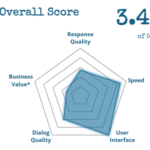 The 9senses Chatbot Audit evaluates the performance of your chatbot from a user perspective.
 Before AI, testing followed specific cycles and became a key part of all DevOps procedures. With AI, things change with every turn. How do quality assurance and testing keep up?
 When we are using generative AI, to create new output we are exploiting knowledge previously generated by humans. But who is rebuilding knowledge for the next generation?
 9senses Market Analysis: Only 16 out of 129 automotive providers in the DACH region use AI chatbots for customer service - with significant variations in quality
 AI lets us skip the slow, clumsy, error-prone work of becoming competent. The bill for that shortcut arrives in the future, when the people who were supposed to replace today's…
 Large Language Models judge your work differently every time you ask. That is not just a quirk of the technology - it is a fundamental challenge to how we create,…
 AI hallucinations aren't random - they cluster, systematically and predictably, in the topics you cannot independently verify.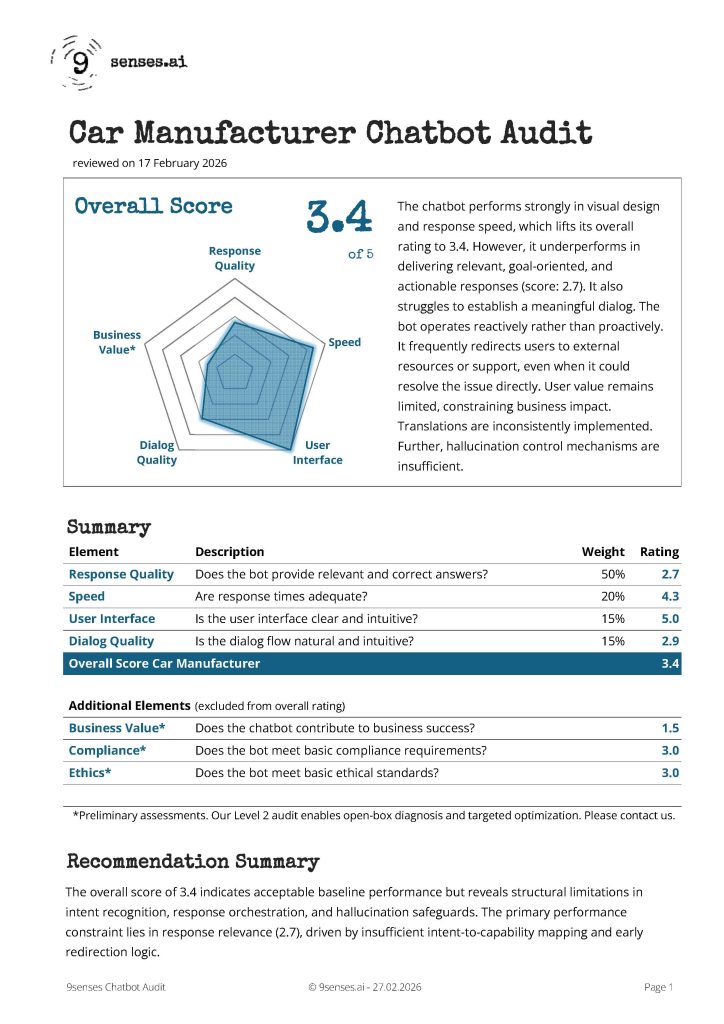
Level 1: Behavioral (black-box) Audit
Level 1 is a standardized external evaluation based on observable behavior at the time of testing. It benchmarks performance, identifies user-facing weaknesses, and delivers a prioritized set of recommendations – without requiring access to the underlying system.
Core Dimensions & Weights
| Dimension | What is evaluated | Weight |
|---|---|---|
| Response Quality | Relevance to the user's goal, factual correctness, completeness, formatting, hallucination robustness, citation behavior | 50% |
| Speed | Latency for simple and complex requests, streaming behavior, perceived speed under load | 20% |
| User Interface | Clarity, usability, layout, readability, affordance design, accessibility signals | 15% |
| Dialog Quality | Conversation flow, expectation management, tone calibration, multi-turn coherence, escalation behavior | 15% |
Additional dimensions are reviewed as outside-in indicators (not part of the Level 1 composite score): Business Value, Compliance, and Ethics. These inform the qualitative narrative and flag areas requiring deeper Level 2 investigation.
Scoring Methodology
Each dimension is scored on a standardized 1–5 scale and aggregated using the weights above into an overall performance score.
| Score | Meaning |
|---|---|
| 1 | Critical deficiency with high user impact or material risk |
| 2 | Significant weaknesses requiring remediation |
| 3 | Acceptable performance with identifiable limitations |
| 4 | Strong performance with minor gaps |
| 5 | Best-practice level: benchmark-worthy performance |
Level 2: Open-Book Audit (Root-Cause Diagnosis)
Level 2 is an open-book audit that explains why the GenAI system behaves as it does. It reviews the technical and organizational system behind the deployment and produces a targeted optimization plan grounded in root causes - not just symptoms.
Open-Book Scope & Outcomes
| Area | What we review (examples) | Typical outcomes |
|---|---|---|
| Architecture & Orchestration | System boundaries, tool/API usage, routing logic, fallback strategy, agentic loops, trust zones, dependency risks | Architecture risk map, refactoring recommendations, safer routing & fallback design |
| Retrieval / RAG Quality | Chunking strategy, retrieval relevance, grounding behavior, citation logic, context window management, stale content risk | Retrieval tuning plan, grounding improvements, measurable answer-quality lift |
| Prompting & Guardrails | System prompts, policy hierarchy, refusal strategy, tool-use permissions, instruction injection robustness, output filters | Hardened prompts, safer policies, reduced jailbreak & prompt injection risk |
| Security & Data Protection | Access controls, secrets handling, data minimization, leakage scenarios, PII exposure, logging sensitivity | Risk remediation plan, control improvements, safer data flows |
| Governance & Operations | Ownership model, human-in-the-loop design, escalation paths, monitoring, incident response, evaluation cadence, change management | Operating model, monitoring design, continuous improvement loop |
| Compliance & Ethics | Transparency & disclosure obligations, data processing mapping, fairness considerations, EU AI Act risk classification, regulated use cases | Compliance readiness checklist, documentation & policy improvements |
| Business Value Modeling | KPI definitions, baseline vs. target, measurement instrumentation, token/run-cost controls, ROI sensitivity analysis | Value case, KPI dashboard spec, cost controls, prioritized roadmap |
Framework Principles
- Anchor: Intended use and business outcomes serve as the primary anchor for defining what "good" means in each context.
- Scope: Applies across Generative AI applications, including customer-facing assistants, internal copilots, knowledge and retrieval systems, document intelligence systems, multi-agent pipelines, and hybrid human+AI workflows.