
how humans process information
(why) 9 senses ?
In modern science, we speak of 8 human senses, sometimes even more. This expands beyond the five traditionally known ones (sight, hearing, touch, taste and smell) into sensory systems inside our body. Below, you can find a few bits of information on each of them. If you click a sense, we will take you on a little journey through our body.
Artificial Intelligence can't and shouldn't replace human intelligence for many reasons, which is why we rather see it as a ninth sense, expanding our human capabilities by yet another dimension, helping us to master our complex world with the support of powerful adaptive computing.
Below, you can learn a little bit more about our capabilities by clicking on a tile. The AI bar shows - from our perspective - how well AI maps our capabilities in each domain. In aggregate, however, human capabilities in moving emotionally, intellectually and physically through our real world are far more powerful than any AI currently is.
How is your chatbot doing?
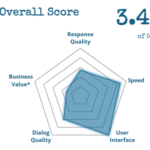
The 9senses Chatbot Audit evaluates the performance of your chatbot from a user perspective.
Talk to Eliza
Talk to Joseph Weizenbaum's Eliza in a replica of the 1966 version.
The end of “done”
Before AI, testing followed specific cycles and became a key part of all DevOps procedures. With AI, things change with every turn. How do quality assurance and testing keep up?
With Generative AI, we risk stealing from our own future
When we are using generative AI, to create new output we are exploiting knowledge previously generated by humans. But who is rebuilding knowledge for the next generation?
AI chatbots in the automotive industry – promise or hype?
9senses Market Analysis: Only 16 out of 129 automotive providers in the DACH region use AI chatbots for customer service - with significant variations in quality
The lost generation
AI lets us skip the slow, clumsy, error-prone work of becoming competent. The bill for that shortcut arrives in the future, when the people who were supposed to replace today's experts never built the ability to judge.
The AI Feedback Lottery
Large Language Models judge your work differently every time you ask. That is not just a quirk of the technology - it is a fundamental challenge to how we create, validate, and trust ideas.
A confident confabulator
AI hallucinations aren't random - they cluster, systematically and predictably, in the topics you cannot independently verify.
- How is your chatbot doing?
 The 9senses Chatbot Audit evaluates the performance of your chatbot from a user perspective.
 - Talk to ElizaTalk to Joseph Weizenbaum's Eliza in a replica of the 1966 version.
- The end of “done”
 Before AI, testing followed specific cycles and became a key part of all DevOps procedures. With AI, things change with every turn. How do quality assurance and testing keep up?
 - With Generative AI, we risk stealing from our own future
 When we are using generative AI, to create new output we are exploiting knowledge previously generated by humans. But who is rebuilding knowledge for the next generation?
 - AI chatbots in the automotive industry – promise or hype?
 9senses Market Analysis: Only 16 out of 129 automotive providers in the DACH region use AI chatbots for customer service - with significant variations in quality
 - The lost generation
 AI lets us skip the slow, clumsy, error-prone work of becoming competent. The bill for that shortcut arrives in the future, when the people who were supposed to replace today's…
 - The AI Feedback Lottery
 Large Language Models judge your work differently every time you ask. That is not just a quirk of the technology - it is a fundamental challenge to how we create,…
 - A confident confabulator
 AI hallucinations aren't random - they cluster, systematically and predictably, in the topics you cannot independently verify.

Reflected light
- Input
- What happens
- Output

Sound wave
- Input
- What happens
- Output

Odor source
- Input
- What happens
- Output

Taste stimulus
- Input
- What happens
- Output


Contact
- Input
- What happens
- Output

Head movement
- Input
- What happens
- Output

Reaching movement
- Input
- What happens
- Output

Internal body state
- Input
- What happens
- Output
“All our knowledge begins with the senses, proceeds then to the understanding, and ends with reason. There is nothing higher than reason.”
Immanuel Kant, Critique of Pure Reason, 1781
Sight
This is one of the most important senses and helps us to orientate ourselves in the physical world around us.
- Humans
- Artificial Intelligence
Hearing
Another essential sense, particularly when it comes to direct interaction between us and the world.
- Humans
- Artificial Intelligence
Touch
Feel and touch gives us the ability to experience things using skin receptors and to handle them carefully.
- Humans
- Artificial Intelligence
Taste
What would the world be without taste? Bland is probably the appropriate word! Do you know umami?
- Humans
- Artificial Intelligence
Smell
Smelling helps us enjoy the world too, but also enables us to notice dangers and other things to avoid...
- Humans
- Artificial Intelligence
Vestibular Sense
The semicircular canals located inside our ears help us position ourselves and keep our balance.
- Humans
- Artificial Intelligence
Proprioception
This sense, provided by sensory receptors inside muscles, tendons and joints, informs us about movement.
- Humans
- Artificial Intelligence
Interoception
This sense provides us with information about what's right or wrong inside our body.
- Humans
- Artificial Intelligence
The only area where computers using Artificial Intelligence truly outperform our human senses today is vision. They can process visual input faster, identify changes and differences more quickly and track much faster motion than the human eye can. When it comes to positioning, computing systems have the ability to use external information (e.g. GPS triangulation) to better orientate themselves. As soon as this information needs to be turned into balancing motion though, humans still win outright. In all other senses, and particularly in the combination of their use, any healthy human does much better.