
Diesen Beitrag anhören
Die verlorene Generation
AI lets us skip the slow, clumsy, error-prone work of becoming competent. The bill for that shortcut arrives in the future, when the people who were supposed to replace today's experts never built the ability to judge.
Diejenigen unter uns, deren Ausbildung und die ersten Schritte im Berufsalltag noch nicht allzu lange zurückliegen, erinnern sich wahrscheinlich mit Schrecken an all die vielen Fehler, die sie als Anfänger gemacht haben. Diejenigen unter uns, bei denen dies schon zu lange her ist, haben dafür oft mit diesen Berufsanfängern zu tun, die sich diese blöden Fehler leisten. Es ist anstrengend, sich mit ihnen zu befassen und kostet uns oft mehr Zeit, als die Dinge selber zu tun.
Dieses Leiden hat mit KI scheinbar ein Ende. Studenten produzieren toll aussehende Arbeiten, Berufsanfänger liefern halbwegs brauchbaren Output - wenn sie denn überhaupt noch gebraucht werden. Experten können sich dank KI auf das Wesentliche konzentrieren. Die Praktikantin braucht keine drei Tage mehr für eine Marktanalyse; das Modell erledigt sie in neunzig Sekunden. Der Berufsanfänger in der Kanzlei entwirft nicht mehr die erste Vertragsfassung; das übernimmt das Modell, und ein Partner schleift sie nach. Alles ist schneller, alle sind produktiver. Eine tolle neue Berufswelt!
Was daran schlecht ist: All diese dummen Fehler von Studentinnen und Berufsanfängern, als Ergebnis dieser mühseligen ersten Gehversuche, die Zeit, die ein Lehrer oder Vorgesetzter damit verschwendet, sie zu korrigieren - dieser Aufwand war nie einfach nur Aufwand, sondern eine Investition in die Zukunft. Genau diese Schritte sind es, die die Anfängerin zur Expertin machen. Indem wir sie dank KI nach und nach aus unserem Alltag entfernen, zerstören wir auch den Teil, den unser Gehirn unabdingbar braucht, um besser zu werden. Die Zeitersparnis ist real und sofort messbar. Die Rechnung dafür ist ebenso real und kommt in der Zukunft.
Es beginnt in der Schule
Noch bevor jemand ins Berufsleben startet, beginnt es in der Schule. Die eigentliche Bedeutung einer Frage erkennen, recherchieren, Gedanken strukturieren, Informationen bewerten, einordnen und zusammenfassen, die Qualität einer Quelle beurteilen und überzeugend argumentieren, das Ergebnis überprüfen: All das gehört zum Kern des Lernens. Und genau diese Aufgaben kann man einem guten Sprachmodell heutzutage überlassen, und es erledigt sie besser als der durchschnittliche Schüler oder Student.
Und die meisten Studenten nutzen KI genau für solche Tätigkeiten. Anthropic hat mehr als eine halbe Million Chats von Studierenden ausgewertet. Die hauptsächliche Nutzung war nicht darauf ausgerichtet, Fakten zu suchen, Argumente zu überprüfen oder Tippfehler auszumerzen. Die Mehrheit der studentischen Nutzer wollte Entwurf und Analyse, die komplexen und anstrengenden Aufgaben menschlichen Denkens, die das Lernen letztendlich zum Lernen machen.
Die Konsequenz daraus ist, dass Schüler und Studenten die kognitiven Fähigkeiten, die zur Lösung komplexer Probleme notwendig sind, gar nie richtig erlernen. Erste Forschungsergebnisse bestätigen dies. Eine Studie aus dem Jahr 2025 mit 666 Teilnehmern ergab, dass stärkere KI-Nutzung mit messbar geringeren Fähigkeiten im kritischen Denken einherging. Eine große Überraschung ist das nicht, wenn man die Aufgabe einem System überlässt. In der Altersgruppe von 17 bis 25 Jahren war der Effekt am stärksten. Diese zeigte die größte KI-Abhängigkeit und die geringsten Werte im kritischen Denken. Eine weitere Studie mit 580 Studenten zeigte denselben negativen Zusammenhang. Dieses Verhalten wird als ‚kognitive Entlastung‘ bezeichnet - eigene Denkleistung wird an externe Hilfsmittel ausgelagert. Und das ist erst der Anfang: Die untersuchten Jahrgänge hatten nur Teile ihrer Ausbildung mit KI absolviert. Was geschieht, wenn jene Studierenden ihren Abschluss machen, die seit der Schulzeit sämtliche Texte an die KI ausgelagert haben?
"Der Nachteil der kognitiven Entlastung bei Erwachsenen ist dass sie das Denken verlernen. Der Nachteil bei Heranwachsenden, die das Denken an KI abgeben, ist eine Generation die sie es gar nie gelernt hat."
Timothy Cook, M.Ed., Psychology Today, 2026
Die Lehrer selbst sind in einem Dilemma. Wo immer ein Essay oder ein Bericht zu bewerten ist, können sie kaum mehr feststellen, wie viel KI darin steckt. Wie verschiedene Studien zeigen, ist die Zeit vorbei, in der sich KI-Text zuverlässig erkennen ließ; Plagiatssoftware kapituliert vor dieser Aufgabe. Eine Lehrerin hat nun zwei Gruppen von Schülern in der Klasse, diejenigen, die KI nutzen, und diejenigen, die es nicht tun. Aber ob etwas Geschriebenes das Produkt harter Arbeit eines klugen Kopfes ist, oder ob KI dahintersteckt, ist kaum mehr festzustellen, zumal womöglich noch versierte Eltern nachgeholfen haben.
Dazu passt ein trauriges Erlebnis der Tochter eines Freundes. Sie hatte drei Wochen Arbeit in ein Projekt in ihrer Schule gesteckt, alles selbst recherchiert und eine fundierte Präsentation erstellt. Ganz ohne KI-Hilfe. Dafür erhielt sie wohlverdient 14 von 15 Punkten. Ein paar ihrer Klassenkameraden allerdings gingen mit 15 Punkten nach Hause, nachdem sie mit Hilfe von KI an einem Nachmittag eine professionell aussehende Präsentation erstellt hatten, und einen weiteren Tag damit zugebracht hatten, die von der KI ausgespuckten Fakten auswendig zu lernen.
Berufseinsteiger - das Dilemma der Unternehmen
Für Berufseinsteiger zieht sich der Arbeitsmarkt bereits spürbar zu. Im ersten Quartal 2026 lag die Arbeitslosigkeit unter Hochschulabsolventen in den USA bei 5,7 Prozent und damit deutlich über der Gesamtquote (New York Fed). Eine Stanford-Analyse beziffert den relativen Beschäftigungsrückgang bei den 22- bis 25-Jährigen zwischen 2022 und 2025 auf 16 Prozent – und zwar in genau den Berufen, die der KI am stärksten ausgesetzt sind, während erfahrene Beschäftigte in denselben Berufen weit weniger zu befürchten hatten. Die neuesten Daten zeigen, dass sich diese Lücke weiter vertieft. Das überrascht nicht: KI erledigt alles, was ein Anfänger erledigt, und zwar besser. Die traurige Wahrheit ist, dass erfahrene Mitarbeitende mit den neuesten Modellen deutlich wertvollere Ergebnisse erzielen, wenn sie selbst mit KI arbeiten, statt die Aufgabe an einen Junior zu übergeben. Ich war Partner in führenden Beratungsunternehmen und programmiere, seit ich fünfzehn bin. Heute schreibe und teste ich Code mit KI-Agenten sehr viel schneller. Eine brauchbare Präsentation entsteht in Stunden, statt dass ich Tage damit verbringe, einen Junior-Berater zu briefen und seine Arbeit durchzusehen. Weil wenn Anfänger ihre Aufgaben mit KI erledigen, kommt oft nicht dasselbe heraus: Ihnen fehlt die Erfahrung, um die KI zu führen und zu beurteilen, was sie liefert. Für erfahrene Kräfte stellt sich damit die unangenehme Frage: Warum sollte ich einem unbeholfenen Neuling meine Anforderungen erklären, wenn ich direkt mit der KI sprechen kann?
Für Unternehmen ist es auf kurze Sicht gewinnbringend, auf die Einstellung von Berufseinsteigern zu verzichten und stattdessen die erfahrenen Mitarbeiterinnen bei der KI-Nutzung zu unterstützen. Die Produktivität steigt, allerdings mit einem großen Nachteil: die nächste Generation erfahrener Arbeitskräfte fehlt. Diejenigen fehlen, die aus Fehlern und dem Input erfahrener Kollegen gelernt haben, und dank ihrer manchmal schmerzhaften Erfahrungen zu Könnern geworden sind. Und selbst die, die noch eingestellt werden, lernen es nicht, sie lernen nur, wie man KI dazu bringt, Dinge zu tun.
Damit setzt sich die KI-bedingte Erfahrungslücke fort. Nach einem dank KI erfolgreich abgeschlossenem Studium, nach einer dank KI-Lebenslauf und KI-Anschreiben erfolgreichen Bewerbung, haben sie mit Glück jetzt diesen ersten Job gefunden. Dort wird erwartet, dass sie KI nutzen, offen oder hinter dem Rücken der Vorgesetzten, weil sie nur so mit denjenigen mithalten können, die es tun. Es ist dieselbe Dynamik, die der Tochter meines Freundes widerfahren ist: wer keine KI nutzt, erzielt ein objektiv schlechteres Ergebnis und braucht mehr Zeit, lernt aber dafür viel mehr für die Zukunft.
Die verfügbaren Daten sind eindeutig: dieser Druck, KI zu verwenden, verheißt nichts Gutes für die Entwicklung der kognitiven Fähigkeiten und den Aufbau von Berufserfahrung.
Das Bildungswesen braucht dringend eine (teure) Reform
In den vergangenen Jahrzehnten haben Universitäten viele Studiengänge auf schriftliche Arbeiten umgestellt, mündliche und schriftliche Prüfungen sind seltener geworden. Die Vorteile sind klar - die reine Bewertung aufgrund elektronischer Dokumente ist viel effizienter, ein wichtiges Argument angesichts zunehmender Studentenzahlen. In der Vergangenheit beinhaltete dies das Risiko von Plagiaten und Ghostwriting, aber der Umfang dieser Probleme war beschränkt und oft aufdeckbar, auch dank Softwaretools wie Turnitin oder PlagAware. Turnitin verkauft inzwischen auch einen KI-Detektor, allerdings mit gemischtem Erfolg.
Die Erfolgsquoten der Detektoren ernüchternd. Einige erkennen zwar unbearbeiteten KI-Text gut – aber nur von älteren Modellen, auf die sie trainiert wurden. In einem begutachteten Test von 160 wissenschaftlichen Arbeiten aus dem Jahr 2026 erkannten drei der vier großen Werkzeuge praktisch keine der vollständig von KI verfassten Einreichungen (Vrije Universiteit Brussel, 2026), und leicht überarbeiteter Text halbiert die Trefferquote mehr als nur: von 39,5 % auf 17,4 % (Perkins et al., 2024). Eine Studie der University of Chicago von 2025 fand nur einen einzigen Detektor, der verschleiertem Text standhielt, und warnte vor einem „technischen Wettrüsten“, das ständige Nachprüfungen erfordert. Schlimmer noch: Die Fehler treffen die Falschen. In einer Stanford-Studie schlugen die Detektoren bei 61 % der Essays von Nicht-Muttersprachlern fälschlich an. Inzwischen haben die Universitäten nachgerechnet. Vanderbilt kam zu dem Schluss, dass rund 750 falsche Verdachtsfälle pro Jahr – bei der von Turnitin angegebenen Fehlerquote von 1 % – zu viele sind, und schaltete das Werkzeug ab; Michigan State, Northwestern und UT Austin folgten.
Fortschritt bedeutet hier einen Schritt zurück in die Vergangenheit, und verschiedene Unis sind schon auf dem Weg dahin. Die Universität von Sydney hat ein "zweigleisiges" Modell entwickelt, das sich auch international verbreitet. Auf der ersten Schiene gibt es Noten für überwachte mündliche und schriftliche Prüfungen ohne KI. Auf der zweiten sind die Arbeiten, bei denen der Einsatz von KI laut internen Leitlinien der Universität ausdrücklich Teil der Aufgabe ist. Die Universität von Bath in England übernimmt ein ähnliches System ab dem Studienjahr 2026/27. Die University of Surrey plant ab September 2026 spezifische Kurse zum Lernen mit KI in jedem Fach, gekoppelt mit veränderten Prüfungen, die echtes Wissen, Fähigkeiten und unabhängiges Denken prüfen.
Clay Shirky, Vizerektor der New York University, sagt klar, dass Unis generell wieder zu mündlichen und schriftlichen Prüfungen in Präsenz zurückkehren müssen; Prüfungen bei denen Fähigkeiten und Wissen in Echtzeit präsentiert werden müssen, von Mensch zu Mensch. Er bezeichnet es als Rückkehr zu einem menschenbezogenen Bildungsmodell. Sokratischer Dialog, die mündliche Verteidigung des Erarbeiteten, der Professorin, die ihre Studierenden kennt, weil sie diese beim Denken beobachtet und mit ihnen interagiert hat.
Leider ist dieser Bildungsansatz, die Rückkehr zu einem studentennahen interaktiven Lernmodell, teuer und für viele Unis nicht finanzierbar. Möglicherweise wird es am Ende eine qualitative Unterscheidung geben zwischen Unis, die KI-Nutzung zertifizieren, und Unis, die kognitive Fähigkeiten und Wissen im herkömmlichen Sinne prüfen.
Die Antwort für Bildungseinrichtungen ist einfach, aber schwer umzusetzen. Die Nutzung von KI muss zum integralen Teil des Lehrplans werden; zugleich müssen die Ergebnisse eine klare Trennung zwischen KI-Output und eigener intellektueller Leistung ermöglichen. Dies zu erreichen wird bedeutet eine enorme Herausforderung für Schulen und Universitäten.
Aber letzten Endes ist es eine gesamtgesellschaftliche Aufgabe für uns alle: sicherzustellen, dass Lernen unsere Kinder dabei unterstützt, ihre eigenen Fähigkeiten zu entfalten.
Welche Möglichkeiten haben Unternehmen?
Unternehmen müssen gerade wichtige Zukunftsentscheidungen treffen. Die Firmen fallen dabei in eine von drei Kategorien. Diejenigen, die sich von KI fernhalten wollen oder sie ohne Mehrwert einsetzen. Diese bleiben bei der Produktivität im Heute stehen. Dann gibt es diejenigen, die KI umsichtig einführen und ihre Mitarbeitenden immer in der Verantwortung halten. Mit diesem Vorgehen erzielen sie gewisse Produktivitätsgewinne dank KI und können diese auch auf Dauer halten. Und dann gibt es die dritte Gruppe von Unternehmen, die erfolgreich auf KI setzen und kurzfristig deutlich an Produktivität gewinnen, dafür aber später teuer bezahlen.
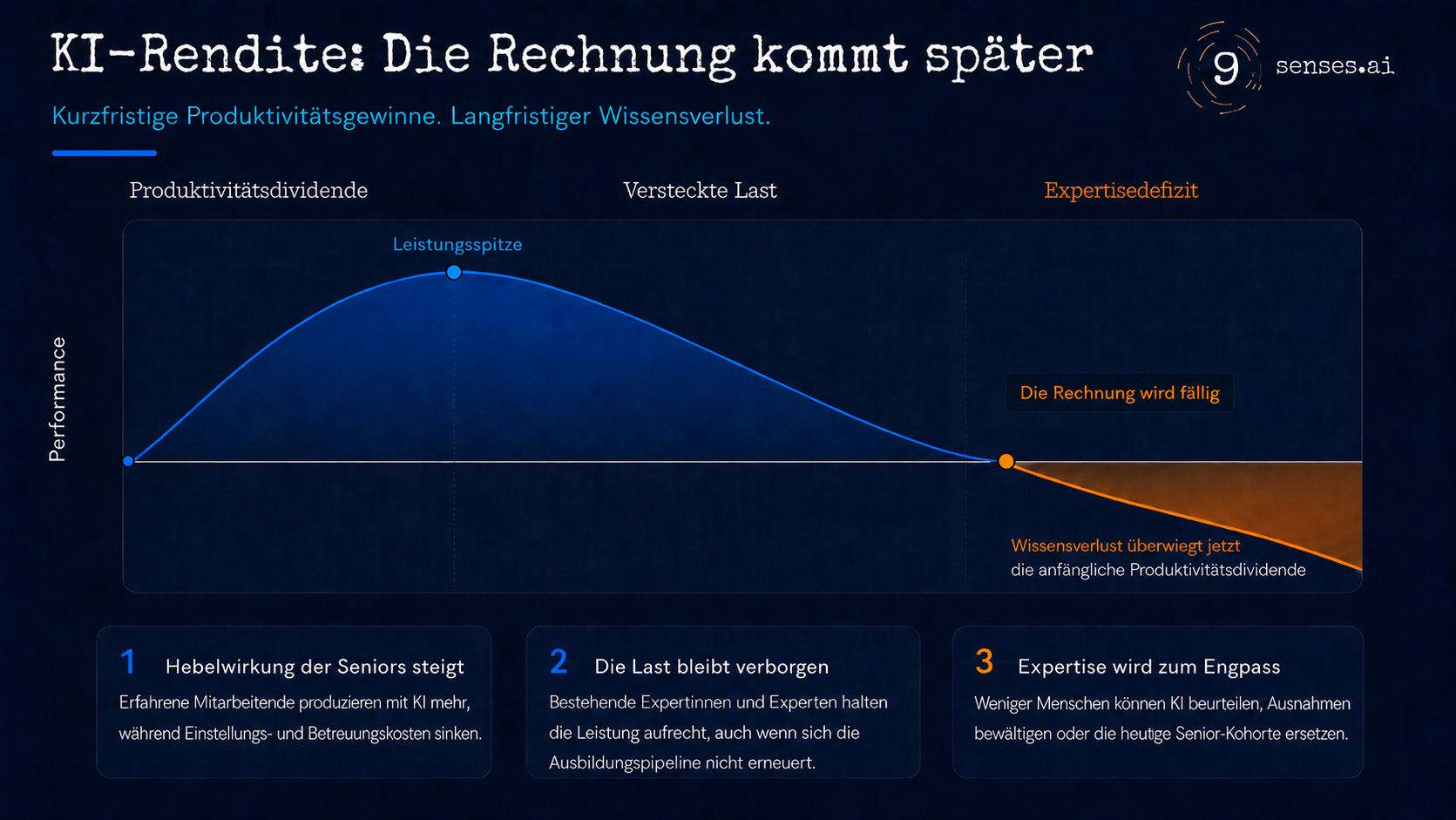 The AI debt curve
Einfach ist die Entscheidung nicht. Gewinne zählen, aber die Zukunft zählt ebenso. Einige Firmen haben sich aktiv dafür entschieden, in den Nachwuchs zu investieren. IBM zum Beispiel kündigt an, die Zahl der Berufseinsteiger in den USA im Jahr 2026 zu verdreifachen. Die Personalchefin begründet das ausdrücklich als Investition in den Nachschub: Wer heute keine Anfänger mehr einstellt, hat in drei bis fünf Jahren keinen Pool erfahrener Fachkräfte mehr. In den ersten Berufsjahren wird darauf Wert gelegt, dass künstliche Intelligenz da eingesetzt wird, wo sie zeitfressende Tätigkeiten optimiert, während Arbeiten, die Erfahrung aufbauen, nicht an die KI delegiert werden. Die Idee dahinter ist, dass sich die Junioren darauf konzentrieren können, Probleme zu erkennen, zu lösen, Ergebnisse zu bewerten und Feedback zu verarbeiten, selbst wenn ein Sprachmodell die Aufgabe schneller lösen könnte. Das erfordert völlig andere Einarbeitungs- und Traineeprogramme: eine Kultur, die beides ausbalanciert, den Umgang mit KI vermittelt und zugleich die Fähigkeit, ihre Ergebnisse zu beurteilen.
"Firmen, die den Lernprozess wegautomatisieren, steigern die kurzfristigen Gewinne, finden sich aber in zehn Jahren in einer Situation, in der niemand mehr beurteilen kann, wie die KI-Arbeitsabläufe funktionieren."
Georgios Petropoulos, MIT Technology Review, 2026
Die richtige Entscheidung liegt auf der Hand, aber sie ist teuer. Wir werden sehen, wie diese Absicht einen wirtschaftlichen Abschwung überlebt, oder sich gegen die Konkurrenz durchsetzt, die KI ohne Grenzen nutzt. Eine einfache Antwort auf diese Fragen gibt es nicht, aber der Diskurs darüber ist notwendig, damit wir uns nicht in dieser Falle kurzfristiger Gewinne wiederfinden, auf die eine lange Krise folgt.
Referenzen und weitere Quellen
Forschung und Daten
Anthropic. (2025, April 8). Anthropic Education Report: How university students use Claude.
Bastani, H., Bastani, O., Sungu, A., Ge, H., Kabakci, O., & Mariman, R. (2025). Generative AI can harm learning. PNAS, 122(26).
Brynjolfsson, E., Chandar, B., & Chen, R. (2025). Canaries in the coal mine? Six facts about the recent employment effects of artificial intelligence. Stanford Digital Economy Lab working paper.
Federal Reserve Bank of New York. (2026). The labor market for recent college graduates.
Gerlich, M. (2025). AI tools in society: Impacts on cognitive offloading and the future of critical thinking. Societies, 15(1), Article 6. DOI: 10.3390/soc15010006.
Jabarian, B., & Imas, A. (2025). Artificial writing and automated detection. Becker Friedman Institute Working Paper No. 2025-116. DOI: 10.2139/ssrn.5407424.
Liang, W., Yuksekgonul, M., Mao, Y., Wu, E., & Zou, J. (2023). GPT detectors are biased against non-native English writers. Patterns, 4(7), Article 100779. DOI: 10.1016/j.patter.2023.100779.
Perkins, M., Roe, J., Vu, B. H., Postma, D., Hickerson, D., McGaughran, J., & Khuat, H. Q. (2024). GenAI detection tools, adversarial techniques and implications for inclusivity in higher education. arXiv preprint arXiv:2403.19148.
Ranganath, S., & Ramesh, A. (2026). StealthRL: Reinforcement learning paraphrase attacks for multi-detector evasion of AI-text detectors. arXiv preprint arXiv:2602.08934.
Shen, J., & Tamkin, A. (2026). How AI impacts skill formation. Anthropic (preprint).
Tian, J., & Zhang, R. (2025). Learners’ AI dependence and critical thinking: The psychological mechanism of cognitive fatigue and the social buffering role of AI literacy. Acta Psychologica, 260, Article 105725. DOI: 10.1016/j.actpsy.2025.105725.
Who wrote this? Evaluating the reliability of AI detection tools in higher education. (2026). International Journal for Educational Integrity. DOI: 10.1007/s40979-026-00226-w.
Universitäten und Policies
Bridgeman, A., & Liu, D. (2024). Frequently asked questions about the two-lane approach to assessment in the age of generative AI. The University of Sydney.
Liu, D., & Bridgeman, A. (2023, July 12). What to do about assessments if we can’t out-design or out-run AI. The University of Sydney.
University of Bath. (2025). The two-lane approach to generative-AI assessment categorisation.
University of Surrey. (2026, April 27). AI to be embedded in every University of Surrey degree.
Vanderbilt University. (2023, August 16). Guidance on AI detection and why Turnitin’s AI detector was disabled.
Kommentare und Berichte zu Unternehmen
Cook, T. (2026, March 17). AI is quietly colonizing how you think. Psychology Today.
McConnon, A. (2026, March 2). The bottom rung returns as AI reshapes entry-level jobs. IBM Think.
McGregor, J. (2026, February 11). Why IBM is “tripling” entry-level hiring as AI reshapes jobs. Charter.
Petropoulos, G. (2026, May 26). It's time to address the looming crisis in entry-level work. MIT Technology Review.
Shirky, C. (2025, August 26). The university’s best weapon against A.I.: The 14th century. The New York Times.